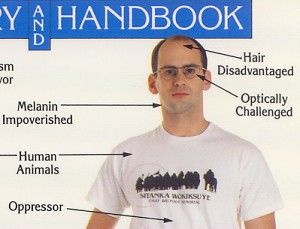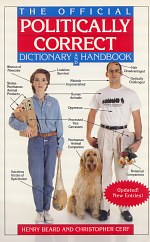
As we continue to recognize the fifteenth anniversary of the original publication of The Official Politically Correct Dictionary and Handbook, by Henry Beard and Christopher Cerf, let us consider the plight of the voiceless victims of speciesism. But how can we consider their plight if we don’t know the exact nature of their oppression? Hence the need for a handy reference work that can enlighten (or is it better to say “encolor?”) us on this matter.
Author Archives: Ron Henzel
A lot of people will like this book.
In fact, a lot of people have liked this book. And isn’t that all that matters? I mean, if you can write in a congenial autobiographical style that makes people feel good by telling them the kinds of things anyone would want to hear, if readers warm up to you the way kids would to a favorite uncle who intrigues them with views different from those of their parents, if you can effectively manipulate the emotional hooks in a story when truth and logic abandon you, does it really matter if your premises are faulty, your facts are few and far between, and the cover of your book is a tad misleading? So what if this book is less than the sum of its parts (much less, actually)! Why can’t we all just be open minded for a change, and if, in the process of opening our minds our brains fall out, so what? If God is bigger than our puny little brains, He shouldn’t care what’s in them, right? So let’s try putting the stuff Philip Gulley and James Mulholland have written in their book, If Grace Is True: Why God Will Save Every Person (San Francisco, CA, USA: HarperSanFrancisco, 2003) into them and see what happens. Continue reading
The Unknown
As we know,
There are known knowns.
There are things we know we know.
We also know
There are known unknowns.
That is to say
We know there are some things we do not know.
Bur there are also unknown unknowns.
The ones we don’t know we don’t know.February 12, 2002, Department of Defense news briefing
—Donald Rumsfeld, as versified by Hart Seely in Pieces of Intelligence: The Existential Poetry of Donald H. Rumsfeld, (New York: Free Press, 2003), 2.
Bruce Manning Metzger (1914-2007)
Today the world of New Testament scholarship mourns the passing of a true giant in that field, Dr. Bruce Metzger. He died yesterday at the age of 93. He was a translator of Scripture and a prolific author of significant scholarly texts. He made important contributions to our understandings of the canon of Scripture, its content, and its background. But he will go down in history for his vast labors in the unglamorous but essential field of the textual criticism of the New Testament.
Co-opted
One of the things I find a tad irritating about Beard and Cerf’s The Official Politically Correct Dictionary and Handbook (New York, NY, USA: Villard Books, updated edition 1993), is that it is actually four separate dictionaries bound in one volume, and it has no index. I know what you’re thinking: you’re thinking that that’s actually two things to be irritated about. Well, when it comes to irritability, I’m a multitasker.
We Wear the Mask
We wear the mask that grins and lies,
It hides our cheeks and shades our eyes,—
This debt we pay to human guile;
With torn and bleeding hearts we smile,
And mouth with myriad subtleties.Why should the world be overwise,
In counting all our tears and sighs?
Nay, let them only see us, while
___We wear the mask.We smile, but, O great Christ our cries
To thee from tortured souls arise.
We sing, but oh the clay is vile
Beneath our feet, and long the mile;
But let the world dream otherwise,
___ We wear the mask.
[Paul Laurence Dunbar, “We Wear the Mask,” in Selected African American Writing from 1760 to 1910, Arthur P. Davis, Jr., J. Sauders Redding, and Joyce Ann Joyce, editors, (New York: Bantam Books, 1991), 281-282.]
The Sola Scriptura of Thomas Aquinas
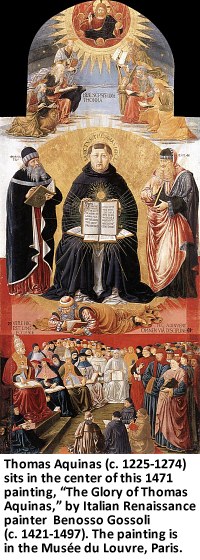
Nevertheless, sacred doctrine makes use of these authorities [i.e., philosophers who are able to know the truth by natural reason] as extrinsic and probable arguments; but properly uses the authority of the canonical Scriptures as an incontrovertible proof, and the authority of the doctors of the Church as one that may properly be used, yet merely as probable. For our faith rests upon the revelation made to the apostles and prophets who wrote the canonical books, and not on the revelations (if any such there are) made to other doctors. Hence Augustine says (Epis. ad Hieron.)1: “Only those books of Scripture which are called canonical have I learned to hold in such honor as to believe their authors have not erred in any way in writing them. But other authors I so read as not to deem everything in their works to be true, merely on account of their having so thought and written, whatever may have been their holiness and learning.”
[Thomas Aquinas (c. 1225-1274), Summa Theologica, First Part, Treatise on God, Question 1, “The Nature and Extent of Sacred Doctrine,” Article 8, “Whether Sacred Doctrine is a Matter of Argument?”, Reply to Objection 2, in Robert Maynard Hutchins, ed., Great Books of the Western World, Volume 19, (Chicago, IL, USA: Encyclopædia Britannica, Inc., 1988), 8.]
ˆ 1There is a discrepancy in my sources for the precise reference of Epis. ad Hieron. (abbreviated Latin for “Epistle to Jerome”). The texts provided by both the Encylopædia Britannica and the Christian Classics Ethereal Library (to which the above bibliographic reference is linked) are based on the translation of the Summa by the Fathers of the English Dominican Province. Britannica’s revision (by Daniel J. Sullivan), however, has properly corrected the reference from Augustine’s 19th (xix) letter (which was not written to Jerome but to Gaius) to his 82nd (lxxxii). Cf. “Letters of St. Augustin,” translated by J.G. Cunningham, in Philip Schaff, ed., Nicene and Post-Nicene Fathers, First Series, Volume 1, (Peabody, MA, USA: Hendrickson Publishers, Inc., reprinted 2004), 350. ˆ
He likes coffee.
He apparently likes it almost as much as I do. This image, created by the amazing jon-e, speaks to me on a very deep level.
To view a step-by-step overview of the process by which he created this masterpiece titled “Mug Shot,” click here. To view it in its original size, click on the image in this post. To view the rest of his online photos, click here.
Present active indicative
It’s difficult to imagine what life would be like without the present active indicative of λύω (luō), “I loose,” or “I destroy.” Continue reading
Reading Romans with John Chrysostom
There is something about the printed page that computer text files have not been able to replace for me. Even though I can take my laptop most places, including to bed, so far I haven’t found anything like the convenience of being able to gently close a book and lay it on a nightstand just as I begin to sink into an unconscious stupor. There’s nothing to turn off, and if I accidentally drop it the consequences are usually slight. Continue reading
Re-controlling a processed tree carcass
So we’re coming up to the fifteenth anniversary of the publication of a Henry Beard’s and Christopher Cerf‘s The Official Politically Correct Dictionary and Handbook (New York, NY, USA: Villard Books, updated edition 1993), and I thought it would be a good idea to hunt down my copy of it and take a look at some of its knee-slapping and yet eerily sobering entries.
You have to start somewhere.
I started with the phone book. Looking up Mensa was not going to be easy, what with having to follow the strict alphabetizing rules that are so common nowadays. I prefer a softer, more fuzzy alphabetizing scheme, one that allows the mind to float free and “happen” upon the word. There is pride in that. The dictionary is a perfect example of overalphabetization, with its harsh rules and every little word neatly in place. It almost makes me want to go on a diet of grapes and waste away to nothing.
—Steve Martin, from “How I Joined Mensa,” in Pure Drivel, (New York, NY, USA: Hyperion, 1999), 62.
Are we coming to another bend in the road?
I was still fairly new to evangelicalism in 1980 when Ronald Reagan first ran for President. I had been a believer for a little more than four years, and up until that year I had not noticed any overall political bias toward either the Democratic or Republican parties among my fellow believers.
But in my local church, a conservative Open Plymouth Brethren assembly, the campaigns of 1980 seemed to create a new a political rift between those who preferred Jimmy Carter because he was a Southern Baptist Sunday school teacher, and those who were fed up with the state of the economy and the low level of national morale and wanted him out. The latter group seemed vaguely aware that Reagan also professed some form of Christian belief, but for the most part did not think that either man’s profession of faith should be a determining factor in whether he was elected.
Is Trichotomy a theological threat?
I posted the following comment to a post titled “Trichotomy–A Beachhead for Gnostic Influences” at The Riddleblog today at about 9:30 a.m. (U.S. Eastern Time):
James Montgomery Boice advocated the trichotomist position in Foundations of the Christian Faith,” revised in one volume, (Downers Grove, IL: InterVarsity Press, 1986), 151-153, and 201-204. On 204 he showed the implications of trichotomy for his doctrine of man when he wrote: “When Adam sinned, the spirit died instantly, with the result that all men and women since are born with what we may call dead spirits. The soul began to die. In that area the contagion may be said to be spreading, with the result that we are increasingly captivated by sin. The remaining part of human nature, the body, dies last.” As I see it, that was about the extent of trichotomism’s impact on his theology. I don’t find it sending him off into the kinds of unbiblical views you cited in other trichotomists. Continue reading
Must Counter-Cult Lay Apologists Also Become Cross-Cultural Missiologists?
I posted the following comment (with a typo corrected) to a post titled “Cross-Cultural Hermeneutics Course Aims: Why Are They Missing Elsewhere?” at John Morehead’s blog today at 12:59 p.m. (U.S. Eastern Time):
John,You wrote: “These goals represent those common in missiology. To what extent do we see them desired, emphasized and utilized among American evangelicals working in the area of new religions and alternative spiritualities in the West? I don’t see much of it. Why is this the case?” Continue reading